Let me tell you about a corner of Athens that the guidebooks haven’t quite figured out yet. They mention it in passing, if at all, as if Plateia Amerikis and Kypseli—two of the city’s most fascinating Athens neighborhoods—were merely the supporting cast in the grand drama of the Acropolis and Plaka. But spend a few days wandering here—through the broad avenues and the narrow side streets, past the crumbling Bauhaus facades and the bustling squares—and you’ll discover something the tourist brochures miss: this is where Athens actually lives.
These are not destinations in the conventional sense. They are not the sort of places you tick off a list between museum visits. They are neighborhoods to inhabit, to get lost in, to sit in a café and watch the world perform its daily rituals. They are, in their own way, a more honest portrait of this ancient city than anything you’ll find in the shadow of the Parthenon.
Chapter One: Plateia Amerikis—The Square That Married America
Let’s begin at Plateia Amerikis (America Square), which is not, despite its name, a sprawling tribute to the United States. It is a traffic circle, essentially—a busy junction where Patission Avenue widens and the city seems to catch its breath before continuing its northward sprawl. But like so many things in Athens, the surface tells you nothing. The story is underneath.
Before it was America Square, it was something else entirely. Until 1927, Athenians called it Plateia Agamon—the Square of the Unwed. The name dated from 1887, when three middle-aged bachelors ran a café on this spot and became, for reasons lost to history, sufficiently famous for their unmarried state that the entire square acquired their condition as its identity. There is something wonderfully Greek about this: a place named not for a battle or a saint or a politician, but for three men who simply never got around to marrying.
In 1927, the municipal council decided that “Square of the Unwed” lacked a certain dignity. They renamed it Plateia Amerikis, in gratitude for American philhellenism. The timing was apt: the United States had played a role in the population exchanges that followed the Greco-Turkish War, and gratitude was in order. So the square acquired its current identity, though the old name lingers in the memories of those who remember when this was still a village on the edge of a growing city.
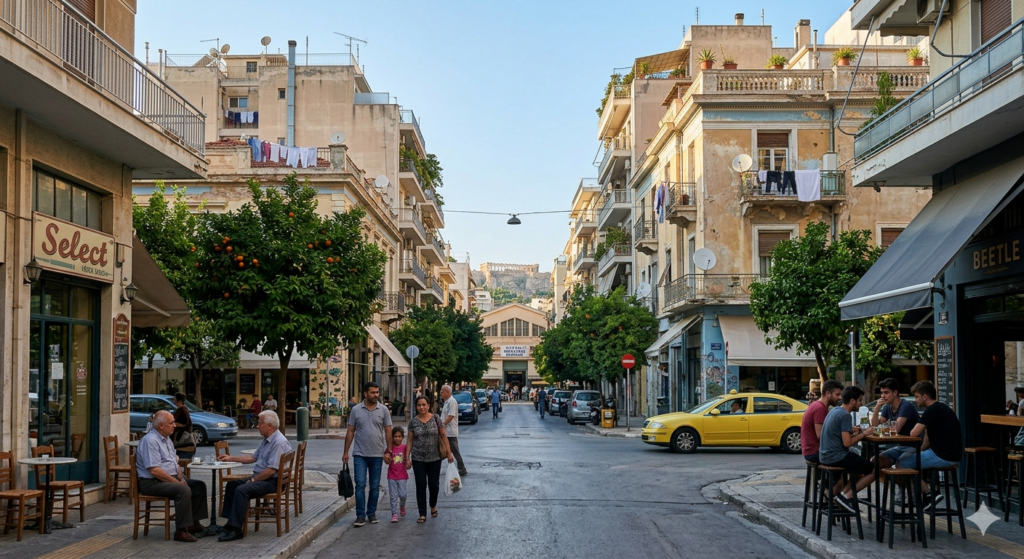
Today, what to see in Plateia Amerikis is less a checklist than an experience. Stand at the square and look south down Patission, and the Acropolis is visible in the distance—a reminder that the ancient city is never far away. The neighborhood around it developed mostly in the 1950s, with apartment buildings that rose to house the waves of migrants flooding into postwar Athens.
Chapter Two: Kypseli—The Hive
From Plateia Amerikis, walk east—past the traffic, past the shops, past the endless stream of humanity that flows along Patission—and you’ll find yourself in Kypseli Athens. The name means “hive,” and it is apt. This is one of the densest neighborhoods in Athens, a place where apartment buildings crowd together and the streets buzz with activity at all hours.
Kypseli history is a story of transformation. It began as a separate village, incorporated into Athens only about a century ago. In the 1930s, development began in earnest, with the construction of single-family homes and the first modern apartment blocks in Athens. The style was influenced by Bauhaus and Art Deco, and traces of both remain if you know where to look. For architecture lovers, Kypseli architecture offers an open-air museum of 20th-century design.
For a few decades, Kypseli was the place to be. In the 1950s and 1960s, it became a hub of nightlife and entertainment, its theaters and cinemas and nightclubs drawing crowds from across the city. The upper and upper-middle classes settled here, attracted by the generous green spaces—Pedion tou Areos park on its southern border, the pedestrian street of Fokionos Negri running through its heart—and the elegant apartment buildings designed by famous architects of the era. Some of those buildings still stand, their faded grandeur a reminder of what the neighborhood once was.
But the 1980s brought change. The original residents moved north to newer suburbs, and in their place came immigrants—from Africa, Asia, Eastern Europe—drawn by affordable rents and the promise of a foothold in the city. The old mansions were subdivided. The grand apartments became crowded flats. Property values fell. For a time, Kypseli off the beaten path slipped from the guidebooks entirely.
Chapter Three: Fokionos Negri—The Spine of Kypseli
If Kypseli has a heart, it is Fokionos Negri street. This pedestrian street runs for more than 600 metres, from Kypseli Square down to Drosopoulou Street, and it is where the neighborhood comes to socialize. Built on an old creek, it is lined with tall trees that offer shade in the summer, benches where the elderly sit and watch the young pass by, and more cafes in Kypseli than any one person could reasonably sample.
In the old days, this was the cosmopolitan heart of Kypseli. The cafes that opened in the 1950s and 1960s drew movie actors and celebrities, and a certain glamour clung to the street like the scent of jasmine on a warm evening. Some of those establishments are still there. Select, a café-pastry shop that opened in 1945, remains a local institution.
But Fokionos Negri today is something else entirely. It is a place where Greek families sit alongside immigrants from Syria and Ethiopia, where the old men playing tavli at one table are neighbors with the young hipsters sipping cocktails at the next. Lisa, a pizza place run by a celebrated pizzaiolo, draws queues that snake down the street. Beetle Bar serves cocktails and snacks to a lively crowd. Topa, a new arrival, offers Basque pintxos with Cretan influences—which sounds improbable but apparently works.
This is the genius of Kypseli: it absorbs everything and remains itself.
Chapter Four: Kypseli Municipal Market and Kypseli Square
The Kypseli Municipal Market stands at the corner of Fokionos Negri, a building with a complicated history. Built in 1935 in Modernist style, it later acquired neoclassical additions that should clash but somehow don’t. For decades, it was a conventional market, the place where locals bought their meat and vegetables. Then it closed. Then it sat empty.
Now it is something else entirely: a community and cultural space, revived as a hub for exhibitions, events, and artisanal products. Pop-up shops appear and disappear. Farmers’ markets fill the courtyard on weekends. Artists exhibit. Musicians play. It has become, improbably, one of the most dynamic spaces in the neighborhood, a symbol of Kypseli’s reinvention. For visitors seeking things to do in Kypseli, the market is an essential stop.
At the traditional center of Kypseli is Kypseli Square, officially named Kanari Square after Konstantinos Kanaris, a hero of the Greek Revolution who lived nearby. A memorial plaque marks the spot at 56 Kypselis Street where he made his home. But the square itself is currently closed, disrupted by the construction of a new metro station that will one day connect this neighborhood to the rest of the city. When it opens—originally promised for 2022, delayed, as these things always are—it will transform Kypseli further. Whether that transformation will be for good or ill remains to be seen.
Chapter Five: Athens Architecture in Kypseli and Plateia Amerikis
Walk the side streets of Kypseli and Plateia Amerikis, and you’ll find yourself in an open-air museum of 20th-century architecture in Athens. The first residences, built in the 1930s, were mainly Neoclassical or Eclectic in style. But as the neighborhood’s reputation grew, wealthier residents commissioned famous architects to design apartment buildings in the latest styles.
Art Deco in Athens. Bauhaus. Mid-century Modernism. All are here, hiding behind the shop signs and the laundry hanging from balconies. Some of these buildings are lovingly maintained, their original features intact. Others are crumbling, their facades scarred by time and neglect. But even in decay, they retain a certain dignity—a reminder that this was once a place where people aspired to something beautiful.A walk along Patission Avenue, which forms the western boundary of both neighborhoods, reveals this architectural history in concentrated form. From the low-key residential vibe at the northern end, past the multicultural bustle around Kypseli, to the more metropolitan atmosphere at Plateia Amerikis where the Acropolis becomes visible in the distance—the street itself tells the story of how Athens grew.
Chapter Six: The New Kypseli—A Neighborhood on the Rise
Something is happening in Kypseli. You can feel it in the air, in the way new businesses open and old spaces find new uses. The guidebooks have started to notice. “Kypseli Athens neighborhood on the rise,” declares one headline. “The Comeback Kid area,” says another.
What they mean is this: a new generation of artists and young professionals, priced out of trendier neighborhoods like Exarchia and Koukaki, has discovered Kypseli. They come for the affordable rents—a studio can still be found for €300–450 a month. They stay for the community, the diversity, the sense that this is a real neighborhood and not a curated tourist experience.
They open ceramics studios like Yoso Art Lab, where you can watch contemporary potters at work. Bookstores like Meteoritis, with its carefully curated selection of Greek literature. Cafés like KICK, where the cookies are apparently not to be missed. Bars like Komna Traka, tucked into a restored bakery with the original sign still hanging outside.
And they sit alongside the older establishments, the ones that have been here for decades, serving the same customers in the same way. At Platanos, under the great plane tree in Plateia Agiou Georgiou, you can eat traditional Greek dishes while the actors from nearby theaters unwind after the curtain falls. At Oi Nostimies Tis Mairis, the food is so good that it draws crowds from across the city.
This is gentrification, yes. But it is gentrification with a difference: the newcomers seem genuinely interested in becoming part of the neighborhood, not replacing it. The Syrian restaurant Tastes of Damascus not only serves excellent vegetarian dishes but also offers training and jobs to asylum-seekers and refugees. The Ethiopian restaurants Lalibela and Habesha have been serving authentic cuisine for years, drawing customers from across the African diaspora.
Chapter Seven: The Multicultural Tapestry of Kypseli
It is impossible to understand Kypseli without understanding its diversity. This is one of the most multicultural neighborhoods in Athens, a place where you can hear a dozen languages on a single street corner.
The immigrants began arriving in the 1980s and 1990s, drawn by the affordable housing that opened up when the original residents fled to the suburbs. They came from Africa—Ethiopia, Nigeria, Somalia. From Asia—the Philippines, Pakistan, Bangladesh. From the Middle East—Syria, Iraq, Palestine. From Eastern Europe—Albania, Bulgaria, Romania.
They opened shops and restaurants, bringing their cuisines and their cultures with them. Today, you can eat Ethiopian injera at Habesha, Syrian falafel at Tastes of Damascus, Georgian khachapuri at Marili bakery. The street markets sell spices and ingredients you won’t find anywhere else in Athens. The Orthodox church of Agios Georgios shares its square with halal butchers and African hair braiders.
This diversity is not always comfortable. There are tensions, as there are in any place where people from different backgrounds are thrown together. But there is also a kind of rough coexistence, a recognition that everyone is here for the same reason: to make a life in a city that offers opportunities their homelands could not.
Chapter Eight: Practical Guide—How to Visit Kypseli and Plateia Amerikis
If you find yourself in Kypseli—and I hope you do—here are some practical things to know.
Is Kypseli safe? The neighborhood is generally safe, though like any urban area, it rewards normal caution. The main streets—Fokionos Negri, Patission, the area around Kypseli Square—are well-lit and busy until late. The quieter side streets can feel deserted at night; use common sense.
How to get to Kypseli: Getting around is easy. The nearest metro is Victoria station on Line 1, about a 10–15 minute walk from central Kypseli. Multiple bus lines run along Patission and Kypseli’s main streets, connecting directly to Syntagma and Omonia. Walking to the center takes about half an hour; Omonia is twenty minutes. Taxis and ride-hailing apps like Beat work well; a ride to Syntagma costs €5–7.
Where to eat in Kypseli: For daily life, you’ll find everything you need. Supermarkets like Sklavenitis and AB Vassilopoulos have locations throughout the neighborhood. The weekly laiki agora (street market) sells fresh fruit, vegetables, cheese, and fish at prices that will make you wonder why you ever shopped anywhere else. Local bakeries (fournoi) sell fresh bread and cheese pies that could fuel a small army.
Cafes in Kypseli: For coffee, you are spoiled for choice. Fokionos Negri is lined with options, from traditional cafeterias to contemporary roasters. Williwaw offers a cozy atmosphere. Cultivos hides a secret back yard. KICK provides a quiet space to work on your laptop. It’s a Village, at Plateia Agiou Georgiou, feels like a village square.
For food, the range is astonishing. Greek tavernas sit alongside Ethiopian restaurants, Syrian cafes next to Georgian bakeries. The prices are reasonable—significantly lower than in the tourist centers—and the quality is high. These are places where locals eat, which is always the best recommendation.
Chapter Nine: The Future of Kypseli and Plateia Amerikis
What will become of Kypseli and Plateia Amerikis? The question hangs in the air, unasked but unavoidable.
The metro is coming. Eventually. When it does, it will bring more visitors, more residents, more money. Rents in Kypseli are already rising—a studio that cost €300 a few years ago now goes for €450 or more. The artists and immigrants who revived the neighborhood may find themselves priced out, as has happened in so many other cities.
But there is reason for hope. Kypseli has been through changes before. It has absorbed wave after wave of newcomers and remained itself. The old and the new coexist here in ways that would seem impossible elsewhere. The Bauhaus apartment building with the Syrian restaurant on the ground floor. The elderly Greek woman sharing a bench with the young African mother. The café that has served the same customers since 1945, now serving flat whites to digital nomads with laptops.
This is not a neighborhood that will be easily transformed. It has too much history, too much density, too much stubborn life. The new arrivals are not displacing the old; they are joining them, adding another layer to a place that has been accumulating layers for a century.
Epilogue: The View from Elikonas Hill
A few blocks north of Kypseli Square, a small hill rises above the apartment buildings. It is called Elikonas Hill, or sometimes Alepotrypa—”Foxhole.” A ten-minute walk from the bustle of Fokionos Negri, and suddenly you are in another world. Pine trees. Paths. The sound of birds, improbably, in the middle of the city.
From the top, the view opens out: the sprawl of Athens to the west, the mountains in the distance, the sea invisible but present. On a clear day, you can watch the sun set over the city, the light softening, the sounds rising from below—traffic and music and voices, the endless hum of urban life.
Stand there, and you understand something about Kypseli that the guidebooks can’t convey. This is a neighborhood of layers: ancient and modern, Greek and foreign, wealthy and poor, all stacked together like the apartments on its streets. It is messy and complicated and sometimes difficult. But it is real. More real, perhaps, than any other place in this city of layers.
The hill has been here for millions of years. The apartments below have been here for less than a century. The people passing through—Greeks, immigrants, travelers, the ones who stay and the ones who move on—are here for the briefest of moments. But in that moment, they are part of something. Part of the hive. Part of the city. Part of the story that began with three unmarried men in a café and continues still.

Boutique urban stays designed for curious travelers looking for a thoughtful base to explore Athens beyond the obvious.
Stay in touch
contact@kistmeturbanstay.com
Discover Kismet
Plan your stay
Direct booking
Deals and offers
FAQ
Contact