Let me tell you about the most important building in Athens.
It’s not the Parthenon, though that’s quite nice if you like that sort of thing. It’s not the Acropolis Museum, which is a masterpiece of modern architecture and definitely worth your fifteen euros. It’s not even the ancient Agora, where Socrates spent his days annoying people with questions they couldn’t answer.
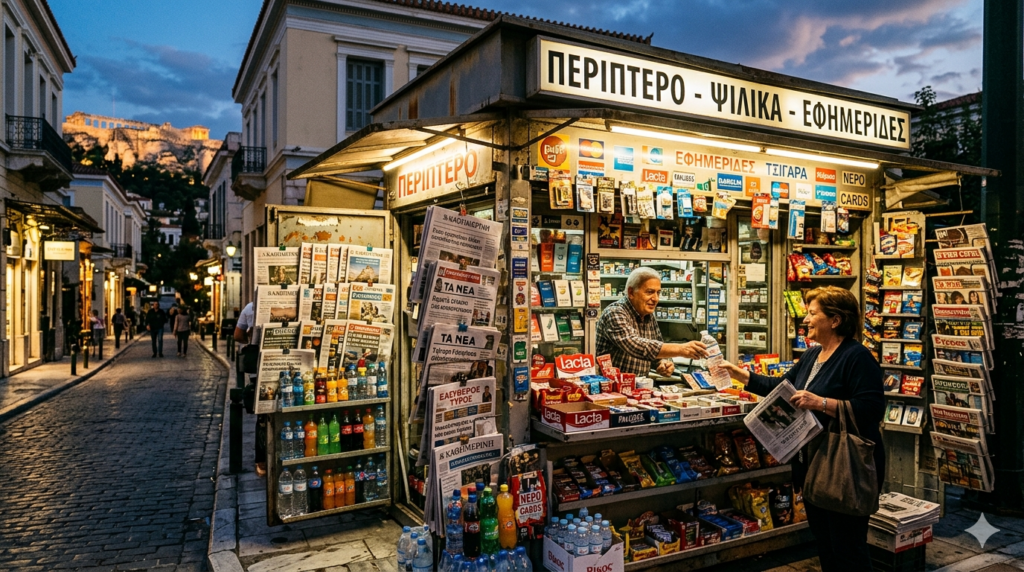
No, the most important building in Athens—the one you’ll use more than any other, the one that will save your life on a hundred different occasions, the one that embodies everything this city is and has been for the past century—is a small, brightly lit kiosk on a street corner. It sells newspapers and cigarettes and bottled water and phone cards and things you didn’t know you needed until you saw them. It’s called a períptero. It’s everywhere. And it is, in its quiet, unassuming way, a miracle.
Chapter One: The Thing That Is Not a Temple
First, a clarification, because the Greeks do love to confuse visitors with their language. When an ancient Greek said períptero, they meant the outer parts of a temple, the colonnaded walkways where philosophers paced and argued and generally made themselves useful. When a modern Greek says períptero, they mean a small metal box on wheels, roughly the size of a garden shed, packed with more merchandise than should physically fit and operated by a person who has been there since approximately 1974 and shows no signs of leaving.
The two could hardly be more different. And yet, standing at a períptero at midnight, buying a bottle of water and a chocolate bar from a man who nods at you like he’s known you for years, you might feel something of that ancient spirit. This is a place of exchange, of encounter, of the small transactions that hold a city together. The philosophers would approve.
Chapter Two: How the Kiosk Came to Be—The Refugee Origin Story
The story of the períptero begins, as so many Greek stories do, with catastrophe.
In the early 1920s, following the Greco-Turkish War and the population exchanges that upended millions of lives, Greece found itself with a problem. It had refugees—hundreds of thousands of them, displaced from Anatolia, arriving with nothing but what they could carry. It also had veterans, wounded men who had fought for their country and now needed something to do, some way to earn a living, some place in a society that was struggling to find its footing.
The solution, as the Greek state saw it, was the períptero. Licenses were granted—first to disabled veterans, then to refugees and their families—allowing them to operate small kiosks on public land. It was social welfare disguised as commerce, a way to give people a foothold in an economy that had none to spare.
This origin matters. It explains why the períptero feels different from a regular shop. It was never just a business. It was a compromise, a kindness, a recognition that society owes something to those who have given something to it. That moral weight persists, even now, even as the city has changed around it.
Chapter Three: A Walk Through the Inventory—What Períptera Sell
Approach a períptero. Any períptero. They’re all different, and they’re all the same.
The exterior is a riot of merchandise. Shelves and racks and rotating displays cover every available surface, arranged with a logic that only the operator fully understands. Newspapers hang from clips, their headlines announcing the day’s disasters in Greek you’re still learning to read. Magazines show photographs of people you’ve never heard of doing things you probably don’t approve of. Cigarettes are displayed in neat rows, each brand with its own devoted customers who will accept no substitute.
Beneath the cigarettes, at eye level for a child, are the sweets. Chocolate bars in wrappers that haven’t changed in decades. Chewing gum in flavours that exist nowhere else on earth. Little packets of biscuits, individually wrapped cakes, things that stick to your teeth and your memories in equal measure.
At the bottom, nearest the ground, are the practical things. Bottled water, because Athens is dry and the sun is merciless. Soft drinks, because sometimes you need sugar and bubbles and artificial colouring. Beer, because the day ends and the evening begins and a cold bottle in your hand is one of life’s genuine pleasures.
Inside the kiosk—though you can’t go inside, you can only peer through the window—there are more things. Phone cards, because the Greek mobile networks are a labyrinth that no foreigner has ever fully navigated. Toiletries, because sometimes you run out of shampoo and the supermarkets are closed. Small household items, the kind you don’t realise you need until you desperately need them. And, increasingly, mobile phone accessories: chargers, cables, cases, screen protectors, the ephemera of modern life that somehow find their way into every corner of the globe.
The períptero operator, meanwhile, sits in the middle of all this like a spider in a particularly well-stocked web. They have a stool, a small space to move, and a perspective on human behaviour that would make a sociologist weep with envy. They see everything. They forget nothing.
Chapter Four: The Operator and His Kingdom—A Day in the Life
I spent an afternoon once sitting near a períptero in Exarcheia, ostensibly reading a book but actually watching the man who ran it. Let’s call him Dimitris, because that was his name and he told it to me eventually, after I’d bought enough bottles of water to warrant conversation.
Dimitris had been at this corner for thirty-two years. He’d watched the neighbourhood change, the students come and go, the anarchists paint their slogans and the city paint over them, the cafes open and close and open again with different names and different clientele. He’d seen children grow up, leave for university, return with children of their own. He’d seen the Greek financial crisis come and the crisis stay and the city adapt in ways that surprised even him.
“The secret,” he told me, “is to be here. Just be here. Every day. Same time. Same place. People need to know you’ll be here. That’s the whole thing.”
He opened at seven in the morning, when the first commuters passed on their way to work. He closed at two the following morning, when the last revelers staggered home from the bars. In between, he sold things, made change, passed the time of day with anyone who stopped. He knew the regulars by name, by order, by the particular way they said hello. He knew the strangers by their hesitation, their confusion, the way they squinted at the unfamiliar products.
It wasn’t a job, exactly. It was a vocation. A way of being present in the world.
Chapter Five: The Social Knot—How Períptera Hold Neighbourhoods Together
This is what the períptero does, beyond commerce. It ties the neighbourhood together.
The transactions are small, but they accumulate. A greeting in the morning. A brief exchange about the weather, which in Athens is always either too hot or too cold and always worth discussing. A shared laugh at something absurd in the newspaper. These are the threads that weave a community, and the períptero is where they’re spun.
In the older neighbourhoods—Plaka, Thiseio, the parts of town that still feel like villages—the períptero becomes an informal information exchange. Where is the best baker? Dimitris knows. Has anyone seen the old woman from number twenty-three? Dimitris saw her yesterday, buying milk. Is there a demonstration planned for this afternoon? Dimitris heard about it from a customer who heard it from someone who knows someone.
The operator becomes, whether they want to or not, a kind of unofficial mayor. They hold the knowledge of the neighbourhood, accumulated over years of watching and listening. They are the first to notice when something changes, when a familiar face stops appearing, when a stranger lingers too long. They are the eyes on the street, the ones Jane Jacobs wrote about, the essential, invisible infrastructure of urban safety.
Chapter Six: The Golden Age of the Greek Kiosk
Ask anyone over fifty about the períptero, and they’ll tell you about the old days. The 1950s, the 1960s, the 1970s—this was the golden age. Athens was growing, spreading, swallowing villages and turning them into suburbs. Every new corner needed a períptero. Every neighbourhood got one. At their peak, there were thousands of them, tens of thousands, more than anyone could count.
In those days, the períptero was more than a convenience. It was a destination. Children saved their pocket money for the sweets. Workers stopped for their morning newspaper and their evening cigarette. Lovers met there, accidentally on purpose, hoping the other would pass by. The kiosk was the centre of everything, the fixed point around which the neighbourhood revolved.
Dimitris remembered those days. “When I started,” he said, “you couldn’t walk ten metres without passing one. They were everywhere. And everyone used them. Everyone. Because where else would you go?”
Then things changed.
Chapter Seven: The Crisis and Its Aftermath
The supermarkets came first. Big places, with fluorescent lights and endless aisles and prices that small operators couldn’t match. Then came the convenience store chains, open late, offering the same products with corporate efficiency. Then came the internet, the digital commerce that doesn’t need a street corner at all.
The Greek debt crisis that began in 2009 made everything harder. People had less money to spend. They bought fewer newspapers, fewer magazines, fewer of the small luxuries that had sustained the períptero for decades. They stretched their euros, made choices, cut back.
The operators felt it first. Their margins, always thin, became thinner. Their customers, always loyal, became occasional. The licenses that had once been a lifeline became a burden, a cost that had to be paid whether the business was thriving or not.
Many closed. The numbers dropped. The empty corners where periptera once stood became a kind of urban elegy, a reminder of what had been lost.
Chapter Eight: Adaptation and Survival—The Kiosk Reinvented
But the períptero, like the city that spawned it, is stubborn.
Those that survived did so by changing. They added new products—phone cards, electronic top-ups, the digital necessities of modern life. They installed card readers, because fewer people carry cash. They stayed open later, because the bars and clubs still needed someone to sell cigarettes to the departing crowd.
Some have become tourist attractions in their own right. In the centre, near Monastiraki and the Acropolis, periptera sell maps and guidebooks and souvenirs, catering to visitors who need directions and water and a moment of orientation. The operators have learned English, or enough English, or at least the English that matters: “Two euros. Thank you. Have a nice day.”
Others have found niches. There’s a períptero near the National Garden that specialises in magazines, every title you can imagine, stacked in towering piles that threaten to avalanche at any moment. There’s one in Kolonaki that sells premium cigarettes and fancy water and the kind of snacks that cost as much as a proper meal elsewhere. There’s one in Exarcheia that seems to sell nothing in particular but is always busy, because the operator—a woman of indeterminate age who has been there since before anyone can remember—has become an institution herself.
The best adaptation, though, is the simplest: they kept being there. In a world of closing times and delivery windows and the complicated logistics of modern commerce, the períptero remained open. At midnight, when the supermarkets are locked and the convenience stores are shuttered and the apps are showing “delivery unavailable,” the períptero is still there, still lit, still selling bottles of water to thirsty travellers who should have planned better.
Chapter Nine: What the Períptero Means in Modern Athens
So what, finally, is the períptero in twenty-first-century Athens?
It’s a survival, first of all. A remnant of a different kind of city, a city of small transactions and human scale, that has somehow persisted into an age that should have rendered it obsolete. It’s an anachronism that works, a dinosaur that kept evolving just enough to avoid extinction.
It’s a convenience, obviously. When you need something small, something quick, something now, the períptero is there. It doesn’t judge you for your needs, doesn’t question your choices, doesn’t require you to navigate a supermarket aisle or wait in a checkout line. It hands you what you want, takes your money, and sends you on your way.
It’s a social knot, still, despite everything. In neighbourhoods where the old ways persist, the períptero remains a point of connection. The operator knows your name, or at least your face. They ask about your family, your work, your day. They are a fixed point in a world that spins too fast.
And it’s a symbol. Of resilience, of adaptation, of the stubborn refusal to disappear that characterises both the períptero and the city it serves. Athens has been sacked, occupied, bombed, and bankrupted. It has been ruled by Romans and Byzantines and Franks and Venetians and Ottomans and Germans and its own disastrous politicians. It is still here. The períptero is still here. They are made of the same stuff.
Chapter Ten: A Practical Guide to Períptera
If you find yourself in Athens—and I hope you do, because it’s magnificent and infuriating and endlessly surprising—here’s how to use the períptero.
| Greek Phrase | Meaning | Use |
|---|---|---|
| Nero | Water | The essential purchase. Still or sparkling. |
| Kafes | Coffee | Though you’re better off getting this at a café. |
| Tsigarila | Cigarettes | If that’s your vice. |
| Efharisto | Thank you | Say it every time. |
| Poso kanei? | How much? | When you’re buying something unfamiliar. |
Practical tips:
- Carry small change. The operators can break a twenty, but they’ll appreciate it if you don’t need to.
- Take a moment. The transaction is quick, but it doesn’t have to be rushed. Look at the displays. Notice what people are buying. Watch the neighbourhood flow past. You’re not just buying water; you’re participating in a ritual that has been unfolding on this corner for decades.
- Stay late. If you’re there at the hour when the bars are closing and the streets are emptying and the city feels like it belongs to you alone, buy something from the períptero that’s still open. The operator is there because people need them to be. Tonight, that person is you.
- Learn the operator’s face. Not their name necessarily—that can feel forced—but their face. Acknowledge them. A nod, a smile, a greeting. It costs nothing and it means everything.
Chapter Eleven: The Future of the Greek Kiosk
What will happen to the períptero? Nobody knows.
The pressures aren’t going away. The economics remain difficult, the competition relentless, the demographic trends unpromising. The operators are ageing, and younger generations aren’t lining up to take their place. It’s not hard to imagine a future in which the períptero becomes a memory, a photograph in a book about old Athens, a thing that used to be.
But it’s also not hard to imagine them continuing, because they always have. They survived the crisis, the supermarkets, the chains, the internet. They survived everything the twentieth century threw at them and most of what the twenty-first has managed so far. They’re small and stubborn and deeply embedded in the fabric of the city.
Dimitris, when I asked him about the future, shrugged. “They said we’d be gone twenty years ago. Thirty years ago. We’re still here.” He gestured at his kiosk, his corner, his kingdom of cigarettes and water and chocolate bars. “Maybe they’ll say it again. Maybe they’ll be right eventually. But not today.”
He was right. Not today. Probably not tomorrow. Probably not for a long time yet.
Epilogue: The Philosopher’s Kiosk
I thought about Dimitris later, walking back through the empty streets, a bottle of water in my hand that I’d bought from his períptero an hour before. I thought about the ancient períptero, the temple walkways where philosophers paced and argued. I thought about Socrates, who spent his days in the Agora, asking questions that annoyed people so much they eventually killed him for it.
Socrates never bought a bottle of water from a kiosk. He never had to. But if he were alive today, I like to think he’d be a períptero regular. He’d stop by in the morning for a newspaper, in the afternoon for a cigarette, in the evening for a beer. He’d chat with the operator, ask questions, learn things. He’d be there, present, engaged, part of the daily rhythm of the city.
Because that’s what the períptero does, finally. It creates a space for presence. In a city that can feel overwhelming, chaotic, too much, it offers a point of stability. A place to stop, to buy, to exchange a few words with someone who will be there tomorrow and the day after and the day after that.
The Parthenon is magnificent. The museums are essential. The ancient sites are worth every euro and every drop of sweat. But if you want to understand Athens—really understand it, the way you understand a person after years of friendship—you need to spend time at a períptero.
Buy something. Anything. Stand there for a moment. Watch the city flow past. The operator will nod at you, or not, depending on their mood and the hour and the accumulated weight of decades behind that window.
You’re not just a customer. You’re part of the ritual. You’re part of the city.
Welcome to Athens. The períptero is waiting.

Boutique urban stays designed for curious travelers looking for a thoughtful base to explore Athens beyond the obvious.
Stay in touch
contact@kistmeturbanstay.com
Discover Kismet
Plan your stay
Direct booking
Deals and offers
FAQ
Contact