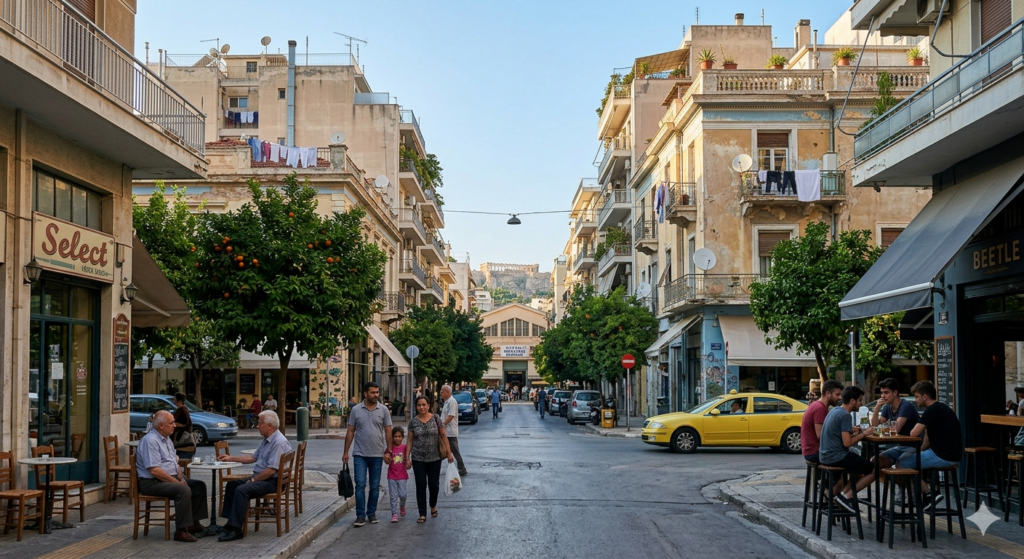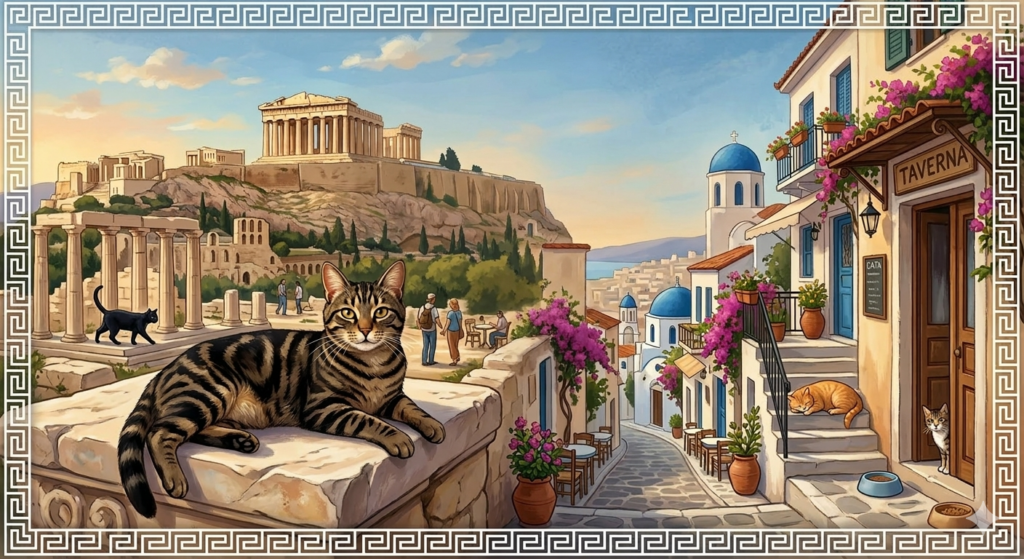
Let me tell you something about the cats of Athens. I don’t mean this as a casual observation, the sort of thing you’d mention over dinner to fill a silence. I mean this as a statement of fact, arrived at after weeks of wandering and considerable thought: the cats run the place. They always have. They always will. We humans are merely passing through, paying rent, providing the occasional tin of tuna.
If you’ve been to Greece, you know this already. If you’ve only seen photographs, you’ve suspected it. What you probably don’t know — what I certainly didn’t know until I started asking questions and annoying perfectly innocent Greeks with my relentless inquiries — is how cats arrived in Greece. The story of the Athenian cat is a tale of smuggling, mythology, and the kind of quiet compassion that restores your faith in humanity just when you’d given up on it.
It begins, as these stories often do, in Egypt.
Chapter One: The Smugglers’ Cargo—How Cats Came to Greece
Here’s a question that had never occurred to me until I found myself sitting in a Plaka café, watching a particularly imperious tortoiseshell stare down a German tourist who’d made the mistake of trying to pet her without proper introduction: when did cats arrive in Greece? The answer, it turns out, is surprisingly late. For thousands of years, Greece got along perfectly well with weasels and ferrets. These were the original pest controllers, the ones who kept the grain stores free of rodents while the Athenians were busy inventing democracy and philosophy.
But the domestic cat — Felis catus, the creature that would eventually evolve into the fluffy dictator sleeping on your laptop keyboard — that was something else entirely. That was Egyptian.
The Egyptians, as you may know, took their cats seriously. We’re not talking about casual appreciation. We’re talking about worship. The goddess Bastet had the head of a cat and the full authority of the divine behind her. Killing a cat, even accidentally, was the sort of mistake you didn’t make twice. The cat mummies you see in museums weren’t just dead pets; they were offerings, sacrifices, expressions of devotion. So when the Egyptians said “you can’t export our cats,” they meant it. These weren’t commodities. They were sacred. Which, of course, meant that smuggling them became an extremely attractive proposition.
Around 1200 B.C. — which is so long ago that even archaeologists have to check their notes — the first domestic cats began appearing in Greece. They arrived on trading ships, hidden among cargo, brought by merchants who’d decided that the profits outweighed the risks. It takes a certain kind of courage, or perhaps a certain kind of greed, to smuggle something that might get you killed if you’re caught. But the cats were valuable. They were better at catching rodents than any weasel. They were, in their quiet, inscrutable way, worth the danger.
And so they came. They stepped off those boats onto Greek soil, looked around at this new land with its hills and its harbours and its abundant supply of mice, and they thought: yes, this will do.
Chapter Two: Cats in Greek Mythology — The Gods Weigh In
Now, you might think that the Greeks, being the Greeks, would have immediately elevated these exotic newcomers to divine status. The Egyptians had done it. The Greeks loved a good god. It seemed inevitable. But no. The Greeks, bless them, were complicated.
Initially, the cat had to compete with the weasel. This is not a sentence I ever expected to write, but there it is. The weasel — or ferret, the sources are frustratingly vague on this point — had been doing the job for centuries. It had seniority. It had connections.
But the cat had something else: charisma. That quiet, aloof quality that makes you feel honoured when it deigns to sit near you. The Greeks noticed. They started putting cats on vases, in sculptures, in the background of domestic scenes. They started writing about them.
The goddess Artemis, the huntress, the protector of young things, became associated with the cat in ways that the Egyptians would have recognised. There’s a certain logic to it: the moon, the hunt, the fierce protection of territory. It fits.
But the Greeks couldn’t leave well enough alone. In another myth — and the Greeks never met a myth they couldn’t complicate — the goddess Hera transforms a servant into a cat and condemns her to the underworld. Suddenly the cat is linked to magic, to darkness, to the sort of supernatural undertones that would, centuries later, get black cats burned in large numbers by people who should have known better.
So the cat’s place in Greek mythology was never simple. It was practical (it caught mice), aesthetic (it looked good on vases), and slightly sinister (Hera was involved). This ambiguity would prove remarkably durable.
The most lasting legacy, though, came from Aesop. You remember Aesop —the storyteller, the fabulist, the man who taught generations of children that slow and steady wins the race. Aesop loved cats. They appear throughout his fables: clever, opportunistic, independent. “The Cat and the Mice.” “The Fox and the Cat.” Each story reinforced the archetype: the cat as survivor, as strategist, as the creature who always lands on its feet.
Three thousand years later, nothing has changed.
Chapter Three: A Walk Through Cat-thens—Famous Felines of the Acropolis
Fast forward a few millennia. Skip the Romans, the Byzantines, the Franks, the Venetians, the Ottomans, the Bavarians, and everyone else who’s had a go at running this place. We arrive in modern Athens, a city of three million people and an uncountable number of stray cats in Greece.
“Cat-thens,” the visitors call it, with the sort of affectionate nickname that usually makes locals roll their eyes. But the locals don’t roll their eyes. They nod. They know. The cats are everywhere. This is not an exaggeration. They are not hiding. They are not shy. They are, in the fullest sense of the word, present.
Start at the Acropolis. Arrive early, before the crowds, before the tour buses disgorge their cargo of sunhatted pilgrims. Walk up the sacred way, past the Theatre of Dionysus, and stop. Look at the stones. The ones that have been here for two and a half thousand years. The ones that have seen empires rise and fall. There is a cat sleeping on them.
This is not remarkable. This is normal. The Acropolis cats have been sleeping on these stones for so long that they’ve probably developed opinions about the various restoration projects. They prefer the ones that haven’t been cleaned yet, the ones with more interesting smells. They shift their positions according to the sun and the season and the whims of feline comfort that no human will ever understand.
A little ginger tom — plump, self-satisfied, clearly well-fed by tourists who should know better — has claimed a spot near the Parthenon itself. He has become famous. People photograph him more than they photograph the Caryatids. Someone started a social media account in his name. His handlers (by which I mean the volunteers who feed him) have had to put him on a diet because so many visitors were giving him treats.
This is Athens. This is the Acropolis. This is a cat named Titan who has better name recognition than most ancient philosophers.
Chapter Four: Community Cats — How Athens Cares for Its Strays
Here’s the thing about Athenian stray cats: they’re not really stray.
The word itself is misleading. It conjures images of mangy, desperate creatures, scavenging in rubbish heaps, avoiding human contact. That’s not what you’ll find here. What you’ll find are what the Greeks call “community cats“. They are fed, watered, sheltered, and cared for by an informal network of locals who have decided, collectively, that this is simply what you do.
Walk through Plaka, that charming labyrinth at the base of the Acropolis. Notice the food bowls outside shops. The water dishes beside doorways. The tiny wooden shelters tucked into corners where the architecture provides a bit of protection from the elements. These are not municipal initiatives. These are not government programmes. These are individual Athenians, doing what needs to be done.
The taverna owners are particularly involved. Watch them during service: they shoo cats away from diners with practiced efficiency, a little wave of the hand, a soft “psst, psst” that the cats largely ignore. Then, after the customers have gone, they emerge from the kitchen with scraps. The cats know this. They’ve been waiting. It’s a ritual, performed nightly across the city, as consistent as the changing of the guard.
But the informal system only goes so far. Behind it, doing the difficult work, are the organisations. Nine Lives Greece is the largest and most visible. Co-founded by Eleni Kefalopoulou, who has been at this for decades, they run a Trap-Neuter-Return (TNR) programme that sterilises nearly two thousand cats every year. Two thousand. Think about the logistics of that: catching them, transporting them, caring for them after surgery, returning them to their territories. It’s the sort of operation that would challenge a well-funded municipal agency, and they do it on donations and determination.
They feed around six hundred cats daily in the historic centre alone. Six hundred. Every day. Rain or shine, tourist season or off-season, economic crisis or recovery. The cats don’t care about any of that. They care about dinner.
What struck me, talking to people involved in this work, was the international dimension. Most of their supporters aren’t Greek. They’re tourists who stumbled upon a feeding session, fell in love with a particular cat, and continued to support the colony from afar. There’s a woman in Canada who sends money every month for a black-and-white tom she met on a street corner in Monastiraki. There’s a couple in Australia who sponsor the food for an entire colony in Thiseio. Athens stray cats have become a global affair.
Chapter Five: The Unsung and the Cautionary—Stray Cats in Omonia
Not all of Athens is Plaka and the Acropolis. Not all of it is pretty. Ioanna Foscolou works with Nine Lives in Omonia, a neighbourhood that doesn’t feature in many tourist brochures. Omonia has problems — crime, poverty, the sort of urban decay that happens when a city stops paying attention. It’s not where you’d expect to find a volunteer cat feeder.
But Ioanna is there, day after day, navigating streets that can be genuinely dangerous, carrying food and water and medical supplies. She wrote an email to the organisation once that someone shared with me. I asked permission to quote it. Here’s what she said: “The daily contact with the stray cats of Omonia fills me with the love they offer me. I continue to feed and treat them because I believe that I am responsible for their lives, because their survival in these conditions that we have forced them to live depends on all of us.”
Read that again. “The conditions that we have forced them to live.” She’s not blaming anyone specifically. She’s not pointing fingers. She’s simply stating a fact: humans made this city, humans created these streets, humans brought these cats here thousands of years ago, and humans therefore have a responsibility.
It’s hard to argue with that.
How to Help Stray Cats in Athens (And What Not to Do)
A word of caution, though, because there’s always a word of caution. The cats are adorable. They are. You’ll want to touch them, photograph them, feed them treats, maybe stuff one in your backpack and take it home.
Do:
- Photograph responsibly — the cats make excellent subjects from a respectful distance
- Support local organisations — Nine Lives Greece accepts donations online
- Leave fresh water — especially in summer, clean water is more valuable than food
- Report injured cats to local volunteers or veterinarians
Don’t:
- Touch or handle — they’re outdoor animals with unknown vaccination status
- Overfeed — Titan the ginger tom didn’t get fat on his own. It took dozens of well-meaning tourists, each thinking “just one more treat,” to create that particular problem
- Attempt to take a cat home — international pet travel is expensive, complicated, and often traumatic for the animal
- Leave food in plastic dishes — they become litter; use paper or remove them
The volunteers now have to manage the consequences of our affection. Feed mindfully, if you feed at all.
Chapter Six: Cyclops and the Cat Distribution System
There’s a theory, popular among cat people, known as the Cat Distribution System. The idea is simple: cats choose you. You don’t find them; they find you. The universe, recognising that you need a cat, delivers one at the appropriate moment. This happens in Athens constantly.
A woman named Aoife, visiting from Ireland, found herself near the Acropolis on a November afternoon. She was tired, slightly overwhelmed, missing home. A one-eyed cat appeared — just appeared, as cats do — and crawled into her jacket. It purred. It settled. It stayed there for hours while she sat on a stone and watched the sun move across the city.
She named it Cyclops. She fell in love with it in the way that travellers fall in love with places and moments and creatures they know they’ll have to leave. She researched bringing it home. Irish pet travel laws are strict, and expensive, and complicated. She couldn’t do it. She had to leave Cyclops behind. The leaving nearly broke her.
Now, every November 25th, she and her husband celebrate Cyclops Day. They spend time with cats — any cats, all cats — and remember the one-eyed creature who crawled into a stranger’s jacket and became, for a few hours, the most important thing in the world.
This is the magic of the Athenian cat. They are not just animals. They are living souvenirs, furry philosophers, teachers of presence and resilience and the peculiar heartache of loving something you can’t keep.
Chapter Seven: What the Cats of Athens Mean
So what, finally, are the cats of Athens?
They’re a link to the ancient past. When you watch a tabby sleeping on a stone that’s been there since Pericles walked these streets, you’re witnessing a continuity that few cities can match. The cats that arrived on those smuggling ships three thousand years ago have never left. Their descendants are still here, still doing what cats do.
They’re a reflection of the Greek character. That pragmatic compassion—the willingness to feed and shelter without fuss or fanfare—says something about how these people see the world. You deal with what’s in front of you. You help because help is needed. You don’t wait for the government or the authorities or anyone else. You just do it.
They’re a lesson in coexistence. Athens is chaotic, noisy, sometimes overwhelming. The cats move through it with a grace that humans can only envy. They’ve figured out how to live among us without becoming like us. They’ve maintained their independence while accepting our assistance. It’s a model of symbiosis that we’d do well to study.
And they’re a reminder that the best things in travel are never planned. You can queue for the Acropolis, check off the museums, photograph every prescribed site. But what you’ll remember, years later, might be something else entirely: a one-eyed cat crawling into your jacket, a tortoiseshell staring you down in Plaka, a ginger tom who got famous for being fed by tourists who should have known better.
The cats of Athens were here before us. They’ll be here after we’re gone. We’re just passing through, providing the occasional tin of tuna, paying our respects to the true Athenians.
They’ve earned it.
Practical Information: Stray Cats in Athens
| Organization | What They Do | How to Support |
|---|---|---|
| Nine Lives Greece | Trap-Neuter-Return, daily feeding of 600+ cats | Donate online, sponsor a colony, volunteer |
| Local Volunteers | Individual feeders like Ioanna in Omonia | Carry food/water, report injured cats |
| Taverna Owners | Informal feeding, shelter, water | Eat locally, leave clean water, don’t overfeed |
Emergency veterinary care: In case of an injured cat, contact a local veterinarian or reach out to Nine Lives Greece via their website for guidance.

Boutique urban stays designed for curious travelers looking for a thoughtful base to explore Athens beyond the obvious.
Stay in touch
contact@kistmeturbanstay.com
Discover Kismet
Plan your stay
Direct booking
Deals and offers
FAQ
Contact